Springtails 101: What They Are and Why Keepers Use Them
Last reviewed October 15, 2026
Springtails are among the most abundant small animals on Earth, living by the hundred thousand in a square metre of healthy soil. Here's what they are, how they work, and why keepers rely on them.
What springtails are#
Springtails make up the class Collembola. They have six legs, like insects, but they're no longer counted as insects: they're a separate branch of the six-legged animals (hexapods), with mouthparts tucked inside the head rather than on the outside. More than 9,000 species have been described, and the lineage is ancient, with fossils from around 400 million years ago.
Most are tiny: usually well under 6 mm, and many are only a millimetre or two. Some are long and slender, others plump or almost round.
How a springtail is built#
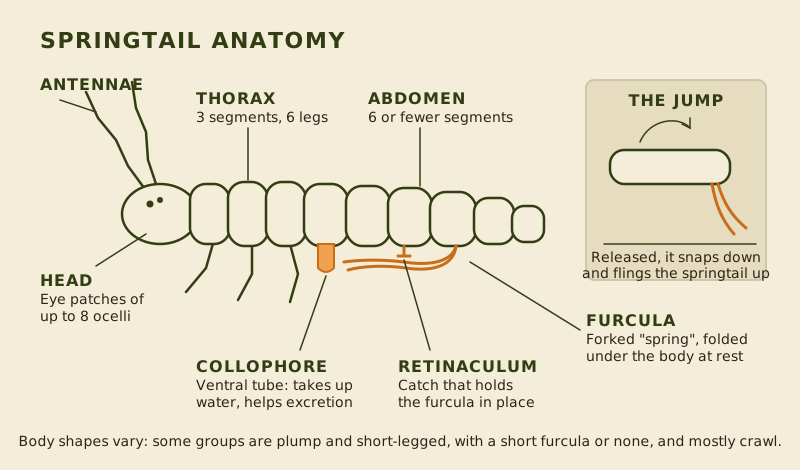
- Furcula: the forked “spring” that gives them their name. It sits under the fourth abdominal segment, held folded by a catch called the retinaculum. When released it strikes the ground in a few milliseconds and flings the springtail into the air. A springtail under 2 mm long can jump up to 16 cm. They use it to escape danger, not to get around, so the landing is close to random.
- Collophore: a small tube under the first abdominal segment. It helps the springtail take up water and handle excretion.
- Not every springtail jumps. Some plump, short-legged groups have a short furcula or none, and mostly crawl.
What they eat#
Springtails mostly eat fungal threads (hyphae) and spores, along with decaying plant material, bacteria and other bits of organic matter. They find food by smell, including the scent of mold. They don't break matter down directly; they speed decomposition by shredding it and keeping microbes in check.
That appetite for mold and decay is exactly why they're kept as a clean-up crew in terrariums and vivariums.
Why they need moisture#
Most springtails have no breathing tubes and breathe through their skin, which makes them very sensitive to drying out. That's why every care step comes back to the same rule: keep them damp, never waterlogged.
How they breed#
Males leave small sperm packets (spermatophores) that females pick up, and some species can reproduce without males at all. Springtails keep moulting throughout their lives. In a culture, keepers typically see babies after a few weeks, with populations growing quickly once a culture settles in after about a month.
Are they harmful?#
No. Springtails don't bite people, don't spread disease and don't damage household items. Claims that they infest people aren't supported by their biology. A few wild species can nibble seedlings in fields and greenhouses, but in a vivarium they're working on mold and decay. They're also a natural food for very small animals such as dart froglets.
Ready to get started? See what to expect when your order arrives.